


Brand names are among the most important elements of a company’s digital identity. Customers use them to find products, search engines use them to understand businesses, and artificial intelligence systems use them to identify and recommend relevant companies. However, the same brand name can appear in several different formats across websites, databases, social media platforms and online marketplaces.
For example, a business might appear as “Microsoft,” “MICROSOFT,” “Microsoft Corporation,” or “Microsoft Corp.” in different records. Although these names may refer to the same organization, software applications may treat them as separate entries without proper normalization.
This is where brand name normalization rules become important. These rules help businesses identify, organize and standardize different versions of brand names into consistent and recognizable records.
Brand normalization is particularly useful for AI-powered search engines, e-commerce websites, customer relationship management systems, digital marketing platforms and product databases.
Whether you manage a WordPress website, an online store or an AI application, implementing a reliable normalization strategy can improve data quality, reduce duplicate records and strengthen brand consistency.
This guide explains how brand normalization works, which rules you should follow and how to implement them using manual methods, automation and artificial intelligence.
What are brand name normalization rules?
Brand name normalization rules are predefined instructions that help convert different representations of a brand name into a consistent format or resolve them to an authoritative brand record.
The process identifies differences in capitalization, punctuation, spacing, spelling, abbreviations and legal suffixes.
For example, consider the following brand variations.
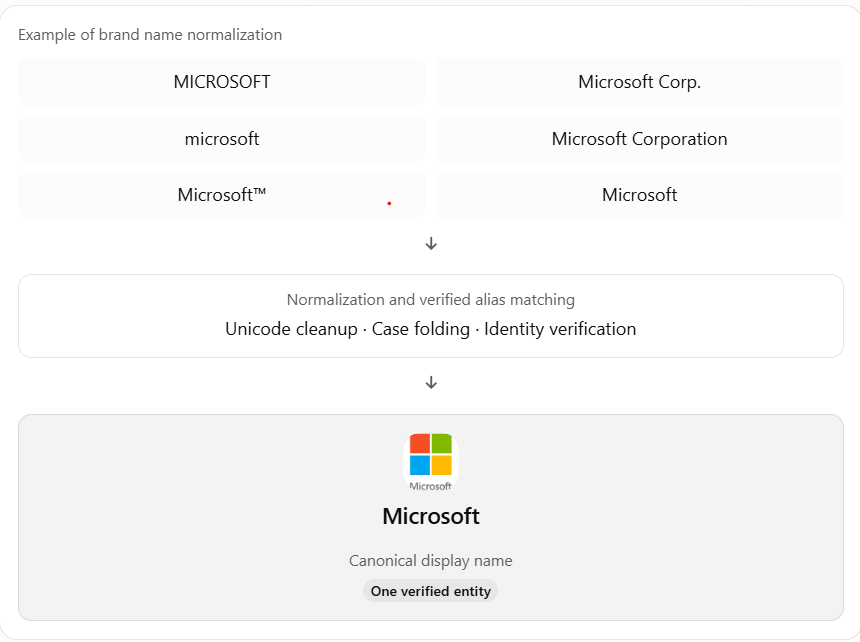
After verification, all these variations can be associated with one brand record.
The primary objective is not to change the company’s actual identity. Instead, it is to make sure that different references to the same business are understood correctly.
A normalization system should identify genuine variations while preventing unrelated businesses from being incorrectly combined.
For instance, Apple Inc., which manufactures electronic devices, should not automatically be associated with every business containing the word “Apple.”
Effective brand name matching requires both text comparison and contextual understanding.
Why is brand name normalization important?
Businesses collect information from numerous sources, including supplier databases, customer forms, product catalogs, search engines and social media platforms.
Without proper brand name normalization rules, these sources can create inconsistent information.
1. Improves data accuracy
Standardized brand records help businesses maintain accurate databases.
For example, an e-commerce website might receive product information from five different suppliers. Each supplier may use a different spelling or capitalization for the same manufacturer.
Normalization can prevent unnecessary duplicate brand categories and improve product organization.
2. Supports AI search visibility
AI search systems need to distinguish between companies, products, services and other entities.
Publishing accurate and consistent brand information can make those relationships easier to understand. However, normalization alone does not guarantee rankings, AI recommendations or citations.
3. Reduces duplicate database records
Duplicate records can create problems in inventory management, customer reporting and sales analysis.
Associating verified brand aliases with a single identifier helps businesses organize related information without losing the original source records.
4. Improves e-commerce navigation
Customers often use brand filters when shopping online.
If one manufacturer appears under three different names, users may not see its complete product range. Consistent brand categories make filtering and product discovery easier.
5. Strengthens brand consistency
Using a consistent public brand name across websites, business directories, social profiles and marketing materials creates a more recognizable identity.
This also helps editorial teams maintain a consistent writing style.
Brand normalization vs. standardization vs. canonicalization
Although these terms are closely related, they perform different functions.
| Feature | Normalization | Standardization | Canonicalization |
|---|---|---|---|
| Main purpose | Make values comparable | Maintain consistent formatting | Establish one authoritative identity |
| Example input | MICROSOFT | Microsoft Corp. | Multiple Microsoft records |
| Example output | microsoft | Microsoft | One verified entity ID |
| Primary use | Data processing | Public brand presentation | Identity management |
| Application | Databases and AI | Websites and marketing | Knowledge graphs and catalogs |
| Main benefit | Easier matching | Consistent appearance | Reduced identity duplication |
Brand name standardization determines how a business name should be displayed publicly. Normalization prepares information for comparison, while canonicalization connects verified variations to a permanent record.
A strong brand management system uses all three processes together.
15 essential brand name normalization rules with examples
A reliable brand normalization system should follow a specific set of rules. These rules should be applied in a logical order to prevent incorrect matching and unnecessary changes to brand identities.
Rule 1: Standardize capitalization
Capitalization is one of the most common differences between brand names stored in multiple databases.
Some suppliers use uppercase letters, while others use lowercase or title case. An internal matching system should compare these names without being affected by capitalization.
| Original brand name | Canonical display name |
|---|---|
| samsung | Samsung |
| SAMSUNG | Samsung |
| SamSung | Samsung |
| adidas | adidas |
| ADIDAS | adidas |
| iphone | iPhone |
| EBAY | eBay |
However, automatically converting every brand name into title case is not recommended. Certain brands use unique capitalization as part of their identity.
Examples include:
- iPhone
- eBay
- YouTube
- PayPal
- McDonald’s
- OpenAI
Use lowercase or case folding for internal comparisons while maintaining an approved display name for public use.
Rule 2: Remove unnecessary spaces
Extra spaces can appear when information is copied from spreadsheets, websites or third-party applications.
These differences may not be visible to customers, but database systems can interpret them as separate records.
| Original value | Normalized value |
|---|---|
Samsung | Samsung |
Coca Cola | Coca Cola |
Nike | Nike |
Sony | Sony |
Remove unnecessary spaces from the beginning and end of each value. Multiple spaces between words should generally be replaced with a single space.
However, removing all spaces between words should only be used as an additional matching technique. Two unrelated brands might otherwise receive the same matching value.
Rule 3: Handle punctuation and special characters
Punctuation marks can create different versions of the same brand name.
Common punctuation differences include hyphens, apostrophes, periods, commas and quotation marks.
| Input variation | Verified display name |
|---|---|
| Coca Cola | Coca-Cola |
| McDonalds | McDonald’s |
| H and M | H&M |
| H & M | H&M |
| Dr Pepper | Dr Pepper |
| Rolls Royce | Rolls-Royce |
These examples illustrate why brand name normalization rules should distinguish between internal matching values and public brand names.
Removing every special character from the final output may damage the brand’s identity. Punctuation-free values can help generate potential matches, but the official spelling should remain unchanged.
Rule 4: Manage legal business suffixes
Many companies include legal suffixes in their registered names. These suffixes may not be necessary when comparing consumer-facing brand names.
Common business suffixes include Inc., LLC, Ltd., LLP, Corp., Corporation, GmbH, PLC and Pvt. Ltd.
| Registered company name | Common public name |
|---|---|
| Apple Inc. | Apple |
| Microsoft Corporation | Microsoft |
| Samsung Electronics Co., Ltd. | Samsung Electronics |
| Tesla, Inc. | Tesla |
| NVIDIA Corporation | NVIDIA |
Legal suffix removal should be used carefully. Businesses with similar names may operate as different registered companies.
The original legal name should always be preserved in a separate database field, particularly when dealing with invoices, contracts, tax information and company registration details.
Rule 5: Apply Unicode normalization
International brands frequently contain accented letters, special symbols and characters from different languages.
Unicode normalization helps software applications process equivalent character representations consistently.
For example:
| Input variation | Preferred display name |
|---|---|
| Nestle | Nestlé |
| L Oreal | L’Oréal |
| Citroen | Citroën |
| Moet & Chandon | Moët & Chandon |
Removing accents can help identify potential matches, but accented and unaccented words are not automatically equivalent in every language.
The Unicode normalization standard describes several normalization forms, including NFC, NFD, NFKC and NFKD. NFC is generally suitable for consistent text storage, while compatibility normalization can be useful for certain internal matching applications. Normalization+1
Rule 6: Maintain a canonical brand name
A canonical brand name is the preferred name used to represent a verified brand within a system.
Every recognized alias should point toward an authoritative record.
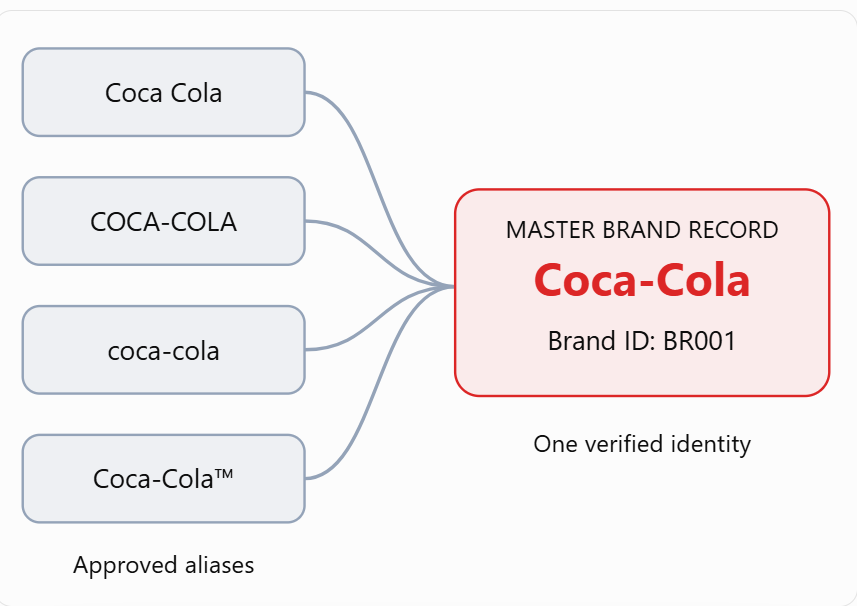
A typical canonical brand record contains a unique brand ID, official display name, registered company name, verified website, approved aliases, industry category and current business status.
The unique identifier is particularly important because a brand name can change over time. The identifier allows historical records to remain connected to the correct entity.
Rule 7: Create a brand alias dictionary
A brand alias dictionary contains verified alternative names associated with recognized brands.
This is one of the most effective brand name normalization rules for businesses managing large amounts of information.
| Brand alias | Canonical name |
|---|---|
| HP | HP |
| Hewlett-Packard (historical context) | HP / legacy entity review |
| IBM | IBM |
| International Business Machines | IBM |
| LG Electronics | LG Electronics |
| L G Electronics | LG Electronics |
| Microsoft Corp. | Microsoft |
Aliases can include abbreviations, historical names, common misspellings, regional names and alternative spellings.
However, historical company names should not automatically be assigned to modern businesses. Corporate mergers, acquisitions and company splits can make historical relationships more complicated.
Rule 8: Correct spelling mistakes using fuzzy matching
Fuzzy matching helps identify names that are similar but not identical.
For example, a customer might accidentally enter the wrong spelling of a popular brand.
| Misspelled input | Suggested brand |
|---|---|
| Samsng | Samsung |
| Microsof | Microsoft |
| Adiddas | adidas |
| Gooogle | |
| Panasonc | Panasonic |
| Lenova | Lenovo |
Fuzzy matching can use algorithms such as Levenshtein distance, Jaro-Winkler similarity and token-based matching.
Tools such as RapidFuzz provide numerical similarity scores to compare strings. These scores measure text similarity rather than the probability that two businesses are identical. RapidFuzz 3.14.6 documentation
Businesses should test their matching thresholds using verified examples before allowing automatic corrections.
A similar name is a candidate for verification, not proof of identity.
Rule 9: Separate parent companies and product brands
One of the most common mistakes in brand data normalization is treating parent companies, subsidiaries and product brands as interchangeable.
For example:
| Parent organization | Brand or product identity |
|---|---|
| Alphabet | |
| Meta | |
| Meta | |
| Microsoft | Xbox |
| Apple | iPhone |
| Toyota Motor Corporation | Lexus |
Although these entities are connected, they represent different identities.
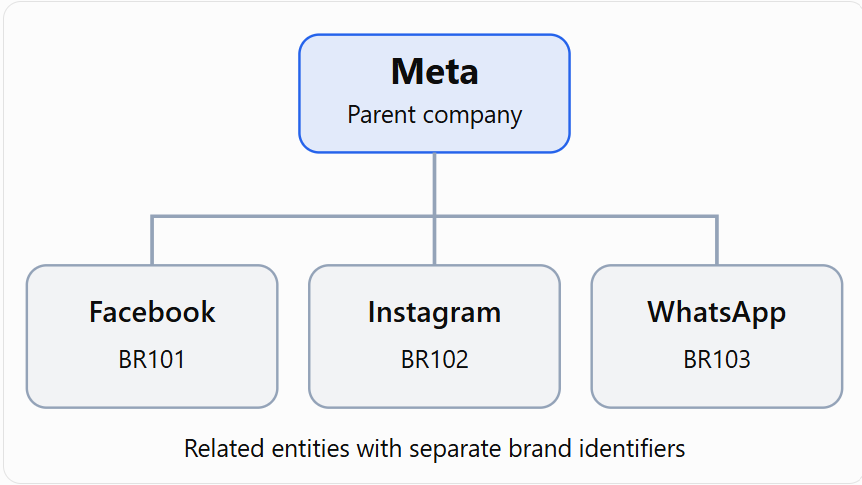
A proper brand database should record the relationships between these entities instead of replacing every product brand with its parent company’s name.
This is particularly important when measuring AI search mentions, product popularity and customer sentiment.
Rule 10: Remove unnecessary trademark symbols
Brand records sometimes contain trademark and registration symbols, including ™, ® and ℠.
These symbols can usually be excluded from internal matching keys.
| Original input | Matching display example |
|---|---|
| Samsung™ | Samsung |
| Nike® | Nike |
| Intel® | Intel |
| Sony™ | Sony |
However, removing a symbol from an internal comparison field does not change the trademark’s legal status.
Businesses should continue following applicable trademark usage guidelines when creating packaging, advertising materials and official documents.
Rule 11: Use contextual information for ambiguous brands
Some brand names are also common English words. These names can be difficult for software applications to identify correctly.
Consider the following examples.
| Brand name | Possible ambiguity | Helpful context |
|---|---|---|
| Apple | Fruit | iPhone, MacBook |
| Amazon | River or rainforest | Shopping, AWS |
| Shell | Natural object | Fuel, petroleum |
| Dove | Bird | Soap, skincare |
| Target | General noun | Retail store, shopping |
| Windows | Building feature | Microsoft, operating system |
AI-powered entity recognition should examine the words surrounding a brand mention.
For example, the sentence “Apple released a new operating system” is more likely to refer to the technology company than the fruit.
Similarly, “I bought apples from the supermarket” should not be counted as a technology brand mention.
Contextual matching is essential when implementing brand name normalization rules for AI-generated responses.
Rule 12: Handle international and regional brand names
Global companies may use different scripts, languages or regional brand names.
| Original name | International name |
|---|---|
| 三星 | Samsung |
| 华为 | Huawei |
| 小米 | Xiaomi |
| ソニー | Sony |
| トヨタ | Toyota |
AI brand normalization tools can help interpret multilingual names and suggest relationships between them.
However, automatic translation should not be treated as final identity verification. The system should compare official websites, product information, company registration records and other reliable sources.
Regional display names should be preserved when they are important to local customers.
Rule 13: Manage brand name changes and rebranding
Businesses occasionally change their names because of restructuring, acquisitions or brand repositioning.
| Historical name | Newer identity | Important distinction |
|---|---|---|
| X | Historical brand mentions may still use Twitter | |
| Facebook, Inc. | Meta Platforms | Facebook remains a separate service brand |
| TransferWise | Wise | Preserve historical records |
| Dunkin’ Donuts | Dunkin’ | Maintain recognized historical aliases |
A master brand database should include the effective dates of name changes.
For example, historical news articles should not automatically have every mention of Twitter replaced with X. The original name may accurately describe the company at the time of publication.
Brand normalization should improve historical reporting rather than rewrite historical facts.
Rule 14: Handle unknown and unverified brand names
Not every product or business record contains enough information to identify a brand.
Common incomplete values include “Unknown,” “N/A,” empty fields and incorrectly entered product descriptions.
A reliable system should classify these records using separate statuses, such as:
| Status | Meaning |
|---|---|
| Verified | Brand identity has been confirmed |
| Unverified | A possible brand exists but requires evidence |
| Unknown | Insufficient information is available |
| Unbranded | Product has no associated brand |
| Needs review | Conflicting or ambiguous information exists |
Google Merchant Center recommends submitting accurate product brand information rather than inventing values or using placeholders for products without a known brand. Google Merchant Center Help+1
Never assign an unrelated popular brand simply because the original field is empty.
Rule 15: Preserve original data and maintain an audit trail
The final rule is to keep the original brand name alongside its normalized value.
This allows businesses to investigate incorrect matches, reverse changes and understand how their records were processed.
| Database field | Example value |
|---|---|
| Original brand name | SAMSNG |
| Suggested brand name | Samsung |
| Brand ID | BR0025 |
| Matching method | Fuzzy matching |
| Verification status | Manually approved |
| Rule version | 1.2 |
| Source | Supplier catalog |
Brand name normalization rules should be documented and updated when new exceptions are discovered.
Maintaining an audit trail is particularly useful when multiple employees, software applications or AI models process the same information.
How to implement brand name normalization rules: Step-by-step guide
Businesses can follow the following practical process to create a reliable brand normalization system.
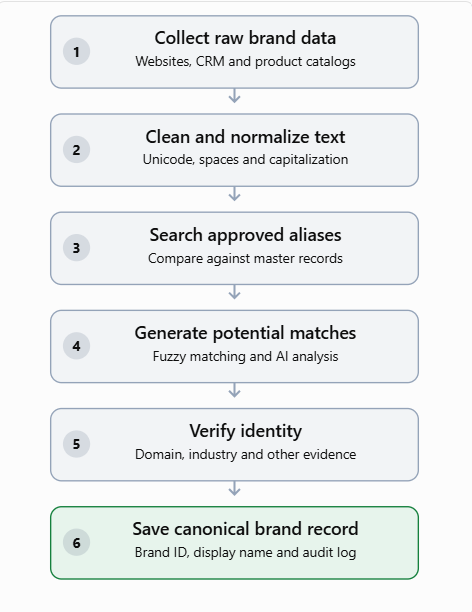
Step 1: Collect brand data from all available sources
Start by identifying the different sources from which your business receives brand information.
These may include supplier spreadsheets, product listings, WordPress databases, online marketplaces, social media accounts, customer records and AI search reports.
Combine this information into a single working spreadsheet or database. Include the original name and its source.
Do not delete records during the initial collection process. Even incorrect spellings can help you identify recurring data quality problems.
Step 2: Create a master brand database
Prepare an authoritative database containing verified brand names.
For small businesses, Microsoft Excel or Google Sheets may be sufficient. Larger businesses can use SQL databases or product information management platforms.
An example master database might look like this:
| Brand ID | Display name | Industry | Official domain |
|---|---|---|---|
| B001 | Apple | Technology | apple.com |
| B002 | Nike | Sportswear | nike.com |
| B003 | Samsung | Electronics | samsung.com |
| B004 | Microsoft | Technology | microsoft.com |
| B005 | Toyota | Automotive | toyota.com |
Always confirm that the website belongs to the specific brand or organization represented by the record.
Step 3: Clean the original brand names
Apply non-destructive text preparation rules.
A basic cleaning operation may include trimming spaces, applying Unicode normalization, creating a case-insensitive matching key and identifying punctuation variations.
Store the result in a new field rather than overwriting the original value.
This makes it easier to identify problems during later stages.
Step 4: Perform exact and alias-based matching
Compare each cleaned name against your master brand database.
If an approved alias matches a unique brand record and there is no conflicting contextual information, assign the corresponding brand identifier.
For example, an approved alias such as “Micro Soft” can be connected to Microsoft if its identity has already been verified.
Exact and alias-based matching should generally run before fuzzy matching because they provide more predictable results.
Step 5: Use fuzzy matching for remaining records
For names that cannot be identified using approved aliases, generate a list of possible matches.
The following thresholds illustrate how you might design a review process. They are not universal industry standards.
| Text similarity score | Suggested action |
|---|---|
| 95–100 | Consider automatic approval only with corroborating evidence |
| 85–94 | Send for manual verification |
| 70–84 | Suggest possible candidates for investigation |
| Below 70 | Retain as unmatched unless other evidence exists |
Thresholds should be adjusted using real data. Short brand names and highly similar competitors often require stricter controls.
Step 6: Verify potential matches
Compare potential matches using supporting information such as official domains, product identifiers, registered company names, verified supplier records, industry classifications and locations.
OpenRefine’s reconciliation approach similarly uses additional contextual properties to narrow down potential entity matches. OpenRefine
Never assume that two records belong to the same brand simply because their names look similar.
Step 7: Save the results and monitor performance
Once a match is approved, store the canonical brand name, unique identifier, matching method and verification status.
Update your reporting tools and product catalogs using the verified identifiers.
Review unmatched records regularly to discover new brands, incorrect supplier information and missing aliases.
Brand name normalization rules AI systems should follow
Artificial intelligence can help businesses process large amounts of unstructured brand information.
Traditional normalization methods depend heavily on predefined rules. AI systems can additionally interpret surrounding text, suggest spelling corrections, identify multilingual names and recognize relationships between brands and products.
A hybrid approach combines predictable rules with AI-assisted analysis.
How AI brand normalization works?
| Technology | Purpose |
|---|---|
| Natural language processing (NLP) | Understand surrounding text |
| Named entity recognition (NER) | Identify potential brand mentions |
| Machine learning | Learn from verified matching examples |
| Fuzzy matching | Find similar spellings |
| Semantic embeddings | Generate contextually related candidates |
| Knowledge graphs | Represent relationships between entities |
| Large language models | Analyze ambiguous names and suggest matches |
AI systems may produce incorrect classifications, particularly when dealing with unfamiliar businesses or short brand names.
For that reason, their outputs should be checked against an approved brand database.
Practical example of AI-powered brand recognition
Consider the following sentence:
I purchased a new Sam Sung television and connected it to my Sony soundbar.
An AI-assisted normalization system might identify:
| Detected text | Suggested brand | Supporting context |
|---|---|---|
| Sam Sung | Samsung | Television |
| Sony | Sony | Soundbar |
The AI model suggests that “Sam Sung” is a spelling variation of Samsung. The application then verifies this suggestion against its brand registry before approving the match.
This approach reduces incorrect assumptions while allowing businesses to process complex text efficiently.
Best AI prompt for brand name normalization
The following prompt can be used with ChatGPT or another language model when processing brand records.
Brand normalization prompt
Act as a brand data normalization specialist.
Compare the supplied brand names against the approved master brand registry.
Preserve official capitalization and punctuation. Identify spelling variations, abbreviations and verified aliases.
Distinguish parent companies, subsidiaries, product names and unrelated businesses. Use contextual evidence where available.
Do not invent brands, websites or identifiers.
Return the original name, suggested canonical name, brand ID, evidence, matching method and verification status.
Mark ambiguous or unknown records as Needs Review. Do not approve uncertain matches automatically.
Approved brand registry:
[Insert registry]
Raw brand names and supporting context:
[Insert data]
This prompt is particularly useful for product catalogs, marketing reports and customer databases.
Avoid submitting confidential customer information to external AI services without appropriate authorization and data protection measures.
How to normalize brand names using Excel?
Microsoft Excel provides a simple way to implement basic brand name normalization rules without advanced programming knowledge.
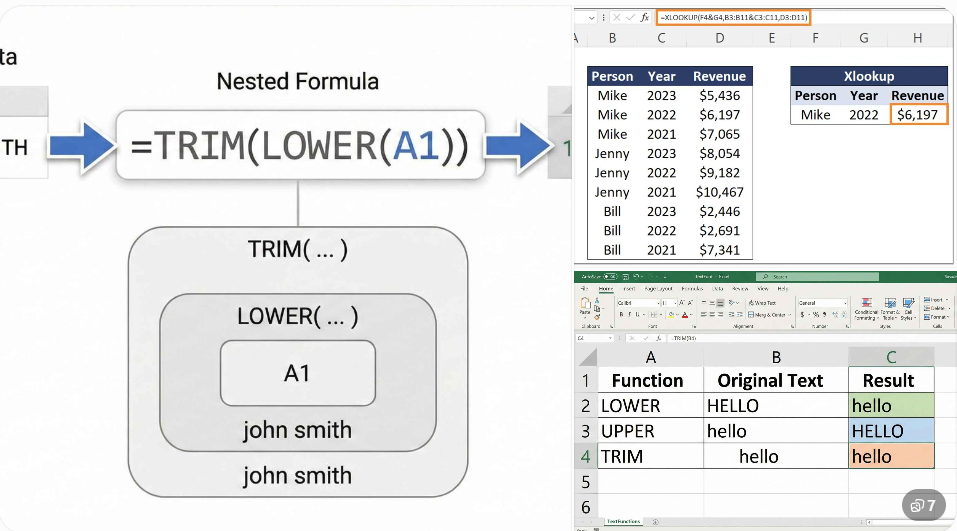
Step 1: Prepare your spreadsheet
Create columns for Original Brand, Cleaned Brand, Canonical Brand, Brand ID and Verification Status.
Create a separate worksheet called Aliases containing approved alias keys in column A and canonical brand names in column B.
Step 2: Remove unnecessary spaces and convert case
Enter the following formula in cell B2:
=LOWER(TRIM(SUBSTITUTE(A2,CHAR(160)," ")))This formula replaces common nonbreaking spaces, removes unnecessary ordinary spaces and converts the text into lowercase.
Step 3: Remove trademark symbols
If the cleaned text contains trademark symbols, use:
=TRIM(SUBSTITUTE(SUBSTITUTE(SUBSTITUTE(B2,"™",""),"®",""),"℠",""))The formula removes common trademark symbols from the matching value.
Step 4: Match names against the master list
Assuming the final cleaned value is in cell C2, use the following XLOOKUP formula:
=XLOOKUP(C2,Aliases!A:A,Aliases!B:B,"Needs Review",0)The formula retrieves the approved display name when an exact alias match exists.
Step 5: Review unmatched brands
Filter the spreadsheet to display records marked “Needs Review.”
Verify these names manually before adding them to the alias dictionary.
This method is suitable for small and medium-sized businesses that do not require advanced automated matching.
How to implement brand name normalization using Python?
Python is suitable for businesses that frequently process thousands of brand records.
The following example applies basic text-cleaning operations and checks the result against a predefined alias dictionary.
import reimport unicodedataBRAND_ALIASES = { "samsung": ("BR001", "Samsung"), "sam sung": ("BR001", "Samsung"), "microsoft": ("BR002", "Microsoft"), "microsoft corp.": ("BR002", "Microsoft"), "microsoft corporation": ("BR002", "Microsoft"), "coca cola": ("BR003", "Coca-Cola"), "coca-cola": ("BR003", "Coca-Cola"), "adidas": ("BR004", "adidas"), "ebay": ("BR005", "eBay")}def normalize_brand_name(name): if not isinstance(name, str) or not name.strip(): return { "original": name, "canonical": None, "status": "Missing" } original = name # Remove trademark symbols before NFKC name = re.sub(r"[™®℠]", "", name) # Prepare the internal matching key name = unicodedata.normalize("NFKC", name) name = name.casefold() name = re.sub(r"\s+", " ", name).strip() # Check approved brand aliases match = BRAND_ALIASES.get(name)Expected results
| Input | Output | Status |
|---|---|---|
| SAMSUNG | Samsung | Alias matched |
| Microsoft Corp. | Microsoft | Alias matched |
| COCA COLA | Coca-Cola | Alias matched |
| ADIDAS | adidas | Alias matched |
| EBAY | eBay | Alias matched |
| Unknown Brand | No assigned brand | Needs Review |
Developers can expand this example by integrating a database, fuzzy matching library, multilingual alias registry or manual verification dashboard.
For production applications, ambiguous aliases should support multiple candidates rather than always returning a single brand.
Brand name normalization rules for SEO and AI search engines
Brand identity is an important part of developing a recognizable online presence.
Search engines use several types of information to understand websites, organizations, products and their relationships.
Consistent information can support accurate entity identification.
1. Use a consistent brand name on your website
Choose an official brand name and use it consistently across your homepage, About Us page, Contact Us page, website header, footer, author profiles and relevant structured data.
Avoid unnecessary variations unless they represent legitimate aliases or historical names.
For example, a website called “TechNova” should not randomly identify itself as “Tech Nova Digital,” “TechNova Technologies” and “TechNova Online” without explaining those relationships.
2. Add Organization structured data
Google recommends Organization structured data to help distinguish an organization from other businesses and improve its understanding of organizational information. Google for Developers
The following is an illustrative JSON-LD example for a fictional organization.
{
  "@context": "https://schema.org",
  "@type": "Organization",
  "@id": "https://example.com/#organization",
  "name": "TechNova",
  "legalName": "TechNova Technologies LLC",
  "alternateName": "TechNova Technologies",
  "url": "https://example.com/",
  "logo": "https://example.com/logo.png"
}
Replace the example values with accurate information about your organization.
You can also add the sameAs property with URLs representing verified profiles of the same organization.
Do not connect unrelated companies or unofficial profiles through sameAs.
3. Implement WebSite structured data
Website names and organizational names can be related, but they serve different purposes.
For example:
{
  "@context": "https://schema.org",
  "@type": "WebSite",
  "@id": "https://example.com/#website",
  "name": "TechNova",
  "alternateName": "TechNova Technologies",
  "url": "https://example.com/",
  "publisher": {
    "@id": "https://example.com/#organization"
  }
}
Google’s site name documentation recommends using a recognizable site name consistently and supports legitimate alternative names through alternateName. Google for Developers
Structured data helps communicate preferences but does not guarantee that a search engine will display a particular name.
4. Maintain consistent social media and directory profiles
Review your official profiles on LinkedIn, Facebook, Instagram, YouTube and other relevant platforms.
Ensure that business descriptions, official website addresses and brand names are accurate.
Local businesses should also check their business listings for inconsistencies in names, addresses and contact details.
5. Distinguish brand normalization from URL canonicalization
Brand canonicalization establishes a preferred identity for an organization or product.
URL canonicalization helps search engines identify a preferred page among duplicate or substantially similar URLs.
These are related data management concepts, but they solve different problems.
Adding a canonical URL does not automatically normalize brand names or connect unrelated business profiles.
How to implement brand normalization in WordPress
WordPress website owners can improve brand consistency without developing a custom application.
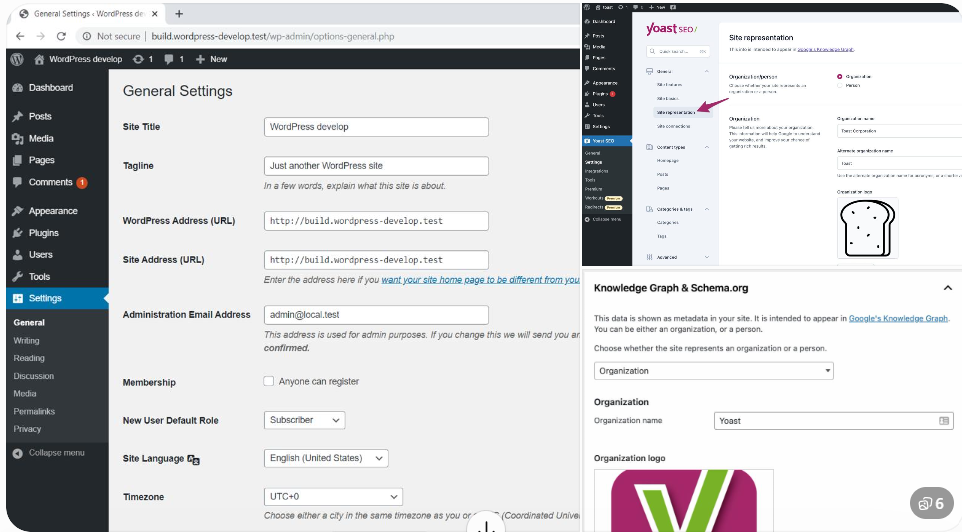
Step 1: Update WordPress general settings
Open your WordPress administration dashboard and navigate to Settings → General.
Review the Site Title, Tagline and website address. Make sure they accurately represent your website.
Step 2: Configure your SEO plugin
If you use Yoast SEO, Rank Math or another SEO plugin, review its website representation and organization settings.
Enter the preferred organization name, official logo and relevant social profiles. Exact menu locations depend on the installed plugin version.
Step 3: Review brand taxonomy
If you operate a WooCommerce store or an affiliate website, check your product brand categories and attributes.
Look for duplicate brand categories caused by capitalization, extra spaces or spelling mistakes.
Before combining categories, verify that they represent the same brand.
Step 4: Update internal links and archives
When verified duplicate brand archives are consolidated, update their internal links and product assignments.
If an old archive URL is permanently retired, implement an appropriate redirect to the equivalent replacement page.
Do not redirect unrelated brands to the same archive simply because their names are similar.
Step 5: Validate structured data
Use the Google Rich Results Test or Schema Markup Validator to check your structured data.
Avoid generating multiple conflicting Organization records through different plugins.
After making changes, use Google Search Console and Bing Webmaster Tools to monitor crawling and indexing.
Brand name normalization rules for e-commerce websites
E-commerce businesses frequently receive product information from multiple suppliers.
Brand variations can affect category organization, search filters, product feeds, advertising campaigns and sales reports.
With verified normalization, customers can find all relevant products under a single brand filter.
However, retailers must distinguish between original products and compatible accessories.
For instance, a third-party charger designed for an Apple iPhone should not automatically be assigned the Apple brand.
Google Merchant Center specifically distinguishes the actual brand of compatible products from the original equipment manufacturer. Google Merchant Center Help
How to measure brand normalization accuracy?
Businesses should evaluate normalization systems before applying changes to large datasets.
The following metrics help identify performance issues.
| Metric | Purpose |
|---|---|
| Match coverage | Percentage of records assigned to a brand |
| Precision | Percentage of accepted matches that are correct |
| Recall | Percentage of genuine matches successfully identified |
| False merge rate | Frequency of unrelated entities incorrectly combined |
| Manual review rate | Percentage of records requiring human verification |
| Unmatched record count | Number of unresolved brand records |
High precision is particularly important when incorrect brand merges could affect product attribution, financial reporting or business identity.
A system that matches fewer records correctly may be more useful than one that automatically matches nearly every record but creates numerous errors.
Best tools for brand name normalization
Several software applications can help businesses implement brand name normalization rules.
- Microsoft Excel
- OpenRefine
- Python
- RapidFuzz
- Google Sheets
- ChatGPT
The best tool depends on the size of your dataset, available technical resources and required level of verification.
Common brand normalization mistakes and how to avoid them
Even well-designed systems can produce incorrect results if their normalization rules are too aggressive.
| Common mistake | Recommended solution |
|---|---|
| Converting every name into title case | Maintain approved official capitalization |
| Removing all punctuation permanently | Preserve the original display name |
| Automatically correcting every misspelling | Verify fuzzy matches |
| Combining parent companies and subsidiaries | Maintain separate entity IDs |
| Deleting original names | Preserve raw records |
| Assigning brands to unknown products | Use an appropriate review status |
| Trusting AI outputs without verification | Validate against reliable sources |
| Ignoring multilingual names | Maintain regional aliases |
| Using outdated brand names | Track historical changes |
| Matching every common word as a brand | Analyze surrounding context |
| Using one similarity threshold for every name | Test category-specific thresholds |
| Combining unrelated businesses | Verify domains and other identifiers |
The most effective brand name normalization rules balance automation, consistency and accuracy.
Also Read:
- Shopify Payout Pending
- Etsy Payment Reserve
- How to Change Your LLC Address With the IRS
- QuickBooks Bank Transactions Not Updating
- Square Instant Transfer Not Available
Frequently asked questions
What are brand name normalization rules?
Brand name normalization rules are instructions used to clean, compare and standardize different versions of brand names. They help handle spelling variations, capitalization, punctuation, abbreviations and unnecessary spaces. Businesses use these rules to improve data accuracy, organize product catalogs, identify duplicate records and maintain consistent brand information across websites, databases and AI-powered applications.
What are brand name normalization rules in AI?
Brand name normalization rules in AI help artificial intelligence systems recognize different references to the same brand. These systems may use natural language processing, contextual analysis, entity recognition and fuzzy matching. AI can suggest relationships between alternative brand names, but the suggested matches should be checked against verified information before they are accepted.
What is an example of brand normalization?
An example of brand normalization is associating “MICROSOFT,” “Microsoft Corp.” and “microsoft” with the canonical display name “Microsoft” after confirming their identity. The original names remain stored separately, while the normalized records point to a common brand identifier. This helps improve reporting, remove duplicate classifications and maintain consistent data.
Does brand normalization improve SEO?
Brand normalization can support SEO by helping website owners publish consistent organization names, product brand details and structured data. It may make brand information easier for search engines to interpret. However, normalization is not a guaranteed ranking factor and cannot replace helpful content, sound technical SEO, website accessibility or a trustworthy online reputation.
What is the difference between brand normalization and brand standardization?
Brand normalization prepares different name variations for comparison and identity matching. Brand standardization determines the approved format used when displaying a brand publicly. For example, converting “EBAY” into the internal matching key “ebay” is normalization, while displaying the verified official name “eBay” is standardization.
What is a canonical brand name?
A canonical brand name is the authoritative display name selected to represent a particular brand in a database or information system. Verified alternative spellings, aliases and abbreviations are connected to the corresponding brand record. A canonical name should normally reflect the organization’s recognized identity and should be supported by a unique identifier.
How can I normalize brand names in Excel?
You can normalize brand names in Excel using functions such as TRIM, LOWER, SUBSTITUTE and XLOOKUP. These functions help remove extra spaces, create case-insensitive matching values, remove selected symbols and retrieve approved brand names from a reference table. Unmatched or ambiguous entries should be manually reviewed before being added to the master database.
Can ChatGPT normalize brand names?
ChatGPT can help identify spelling differences, suggest canonical brand names and analyze contextual information. It can also assist with creating alias dictionaries and normalization scripts. However, it may incorrectly identify unfamiliar brands or suggest unsupported relationships. Businesses should provide an approved master registry and verify uncertain results before making permanent changes.
Should legal suffixes be removed from brand names?
Legal suffixes such as Inc., LLC and Ltd. can sometimes be excluded from internal matching keys to improve comparison. However, they should not be permanently removed from registered company information. Businesses should preserve their complete legal names and use additional evidence to distinguish similarly named organizations.
What is brand entity resolution?
Brand entity resolution is the process of determining whether different records refer to the same real-world brand. It goes beyond basic text cleaning by examining contextual information, official websites, business identifiers, product details and organizational relationships. Entity resolution helps prevent unrelated businesses from being incorrectly grouped together.
Which algorithm is best for brand name matching?
There is no single algorithm that performs best for every brand dataset. Levenshtein distance, Jaro-Winkler similarity and token-based matching are common techniques. Businesses should combine suitable algorithms with exact matching, approved aliases and contextual verification. The final choice should be based on performance testing with representative brand records.
Are brand name normalization rules universal?
No. Although common techniques such as whitespace cleanup, case folding and alias matching are widely used, individual businesses need different rules. Industries, languages, legal requirements and product categories influence how normalization should work. Every organization should develop and test its own rules using accurate reference data.
How do I handle duplicate brands in WooCommerce?
Start by identifying brand categories and attributes with similar names. Verify whether they represent the same brand before combining them. Select the preferred brand record, reassign the associated products and update relevant internal links. If duplicate archive pages are permanently removed, redirect equivalent old URLs to the appropriate replacement pages.
Can brand normalization help AI search visibility?
Consistent brand names, accurate structured data and verified business profiles can help AI applications interpret organizational information. Normalization can also improve the accuracy of internal AI visibility reports by combining verified alternative brand mentions. However, no normalization method guarantees recommendations, citations or higher visibility across AI answer engines.
How often should brand normalization rules be updated?
Businesses should review their rules whenever new brands, aliases, suppliers or significant rebranding events appear. A monthly review may be appropriate for frequently updated product catalogs, while smaller businesses may conduct quarterly audits. Monitoring unresolved matches can help determine when new normalization rules or exceptions are necessary.
Conclusion
Brand name normalization rules play an important role in modern data management, e-commerce, digital marketing and artificial intelligence applications.
They help businesses organize inconsistent brand records, improve reporting accuracy, reduce unnecessary duplication and maintain a recognizable online identity.
A successful normalization strategy begins with simple text cleaning and develops into a structured system that includes verified aliases, canonical brand names, unique identifiers, contextual analysis and manual review.
Whether you use Excel, Python, WordPress or AI-powered applications, the objective should remain the same: identify brands accurately without incorrectly combining distinct businesses.
By implementing the brand name normalization rules explained in this guide, organizations can develop more reliable databases, improve customer experiences and create a stronger foundation for AI-assisted information processing.