

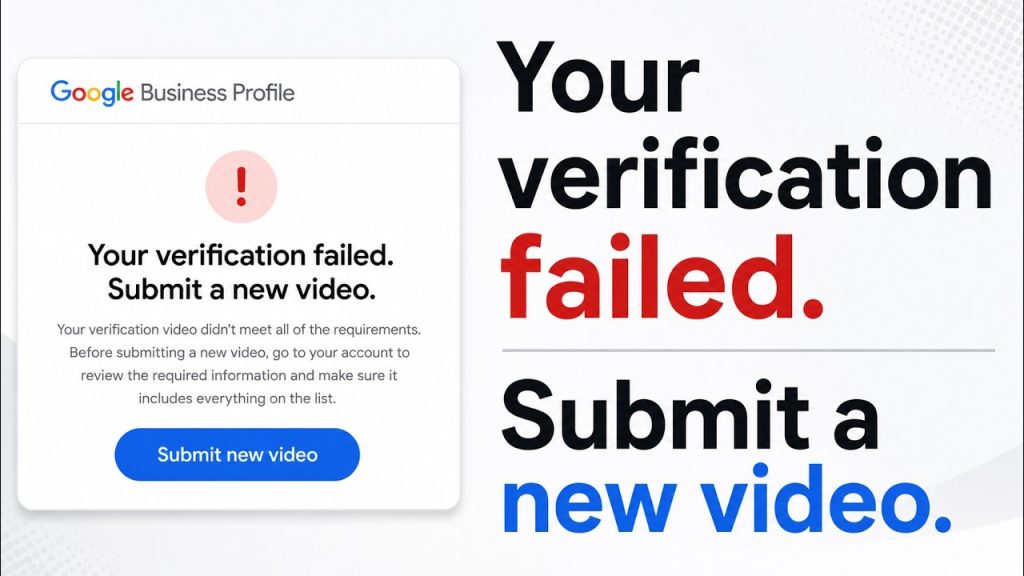
A Video Verification failed can keep a legitimate local business from managing its Google Search and Maps listing. The best response is not to record the same clip again. First determine whether Google could identify your location, see your real-world business, and confirm that you are authorized to manage it.
Quick answer
Record one continuous, unedited video of at least 30 seconds inside the live mobile verification flow. Show location context, business evidence and proof of management appropriate to your business type. If Google rejects it, review the indicated issues before submitting another recording.
Information check: Guidance reviewed November 12, 2026. Interfaces, fees, processing windows and state requirements may change. Always follow the official provider guidance for your exact account.
What this guide covers?
This article is for readers researching “Google Business Profile video verification failed” in the United States. It separates the official process from common misunderstandings, outlines a practical sequence and gives you a way to check the result. Start with the quick answer when you need the immediate fix, then work through the numbered steps only as far as your own situation requires.
- The key status or eligibility checks to make before acting
- A detailed numbered procedure with verification checkpoints
- Real-life business scenarios showing how the answer can differ
- A troubleshooting table and mistakes that can make the problem worse
- Seven reader questions with concise, practical answers
- Direct links to official documentation and useful related guides
Before you begin
Use an account you are authorized to manage and verify that you are working with the correct business entity, store, bank connection or listing. Save existing records before making irreversible changes. Do not send passwords, complete banking numbers, tax identification numbers or private customer details to strangers offering help. If the procedure involves legal compliance or tax treatment, consider advice from a qualified U.S. professional familiar with your facts and state.
Step-by-step guide: Google Business Profile Video Verification Failed
Step 1: Check the exact verification status
Sign in with the Google account managing the profile and search for the business. Open its verification prompts. Distinguish “processing,” “not successful,” and an upload failure: they call for different responses. Record the date and the wording shown, without sharing sensitive account information in public forums.
What to prepare before this step
Keep a copy of the most recent account notice, your official business records and the date the issue first occurred. Note the precise label visible in your account rather than relying on memories of a similar problem. Where more than one owner or staff member manages the account, agree on who will make changes so two people do not unknowingly undo each other’s work.
At this stage, the most reliable next move is the one supported by the actual status and documentation in front of you. Do not repeat the entire process without first checking what changed; repeating a completed action can create duplicates or unnecessary delays.
Step 2: Confirm that the business is eligible
A storefront must have a real customer-facing presence; a service-area business can serve customers at their locations without showing its home address. An online-only store with no in-person contact generally is not eligible for a Business Profile. Changing the business category will not fix a genuine eligibility problem.
How to tell whether the step worked
Compare the result with the original problem, not merely with a successful click or a confirmation banner. An updated setting might still take time to appear in a public listing, bank feed or official record. Capture the new status, record any reference number and identify the next action only if the expected outcome is still missing.
At this stage, the most reliable next move is the one supported by the actual status and documentation in front of you. Do not repeat the entire process without first checking what changed; repeating a completed action can create duplicates or unnecessary delays.
Step 3: Plan a single continuous route
Before tapping record, decide how you will move from nearby street landmarks to your storefront or work equipment and finally to a management-only area. Google requires a unique, unedited live recording, so do not assemble clips or upload an existing file. Ensure all three forms of evidence fit into one coherent walk-through.
A practical example
Imagine a small U.S. business owner carrying out this procedure while a customer, lender or accountant is waiting for an answer. The useful evidence is a specific status, date and authorized record—not a guess that the service must have completed the work. This distinction makes the next conversation with official support much more productive.
At this stage, the most reliable next move is the one supported by the actual status and documentation in front of you. Do not repeat the entire process without first checking what changed; repeating a completed action can create duplicates or unnecessary delays.
Step 4: Show an identifiable location
For a storefront, begin with the street and nearby buildings, then capture permanent exterior signage matching the listing name. For a home-based service-area business, show nearby location markers without exposing unnecessary private details. Avoid a video filmed entirely inside an anonymous room.
When to stop and verify
Stop when the interface asks for information you cannot confirm from company records, a payment you do not recognize, or an action that might erase existing data. Before continuing, check the official provider documentation linked below. A few minutes of verification can prevent a permanent change or a second, avoidable support case.
At this stage, the most reliable next move is the one supported by the actual status and documentation in front of you. Do not repeat the entire process without first checking what changed; repeating a completed action can create duplicates or unnecessary delays.
Step 5: Demonstrate that the business actually operates
A salon might show workstations and supplies; a plumber could show branded equipment and work tools. A storefront might show its stock or counter. Evidence should reflect the business category listed in the profile rather than generic office furniture that could belong to anyone.
What not to confuse with this step
Many business systems display similar words for different stages: pending, submitted, under review, completed and failed can each carry a specific meaning. A request being submitted does not guarantee approval, and an account showing a transaction does not prove funds have reached the destination bank. Follow the actual status definition for this service.
At this stage, the most reliable next move is the one supported by the actual status and documentation in front of you. Do not repeat the entire process without first checking what changed; repeating a completed action can create duplicates or unnecessary delays.
Step 6: Prove you manage or represent it
Record an action available to authorized staff: unlocking the shop, entering an employee-only area, operating the point-of-sale terminal, or opening a work vehicle. Do not show account credentials, private customer data, identity documents, bank details, or confidential files on camera.
How to keep a useful paper trail
Make a short entry in your business operations log with the responsible person, the action taken and the outcome. Store business documents in a secure location rather than an open spreadsheet shared publicly. If you later need to contact support, this record helps you explain the sequence without making contradictory claims.
At this stage, the most reliable next move is the one supported by the actual status and documentation in front of you. Do not repeat the entire process without first checking what changed; repeating a completed action can create duplicates or unnecessary delays.
Step 7: Record through the mobile prompt
On your phone, open the profile verification flow and follow its recording and upload prompts. Keep the connection steady, grant camera permission if requested and avoid switching apps during capture. Use the phone directly; videos recorded elsewhere and uploaded afterward are not the supported method.
A risk worth avoiding
Do not use unofficial browser extensions, purchased account access, made-up evidence or third-party “instant fix” services to bypass an official workflow. These shortcuts can expose credentials or create another compliance issue. The safest option is to work within the provider’s documented eligibility rules and authenticated support process.
At this stage, the most reliable next move is the one supported by the actual status and documentation in front of you. Do not repeat the entire process without first checking what changed; repeating a completed action can create duplicates or unnecessary delays.
Step 8: Read the rejection details and correct only what is missing
If Google requests another video, use Review issues when available. For example, “business name not visible” means you should plan an uninterrupted route that clearly frames permanent signage. If “authorization” is missing, include a management-only action rather than adding more shots of the street.
Planning for the next step
Before moving on, check whether the result changed another part of the business workflow: public contact details, payout timing, customer promises, bank reconciliation or tax reporting. A single change can have downstream effects even when the action itself looks small. Keep dependent systems in mind rather than treating each account as isolated.
At this stage, the most reliable next move is the one supported by the actual status and documentation in front of you. Do not repeat the entire process without first checking what changed; repeating a completed action can create duplicates or unnecessary delays.
Step 9: Wait for a decision and use support appropriately
Google says video review can take up to five business days. Repeated submissions before the displayed decision may create confusion. If the video is still rejected after you address the stated issue, use another verification option only if Google offers one or follow the support path shown in your profile.
A good final check
Read the details one last time. Names, dates, account mappings, addresses and amounts are easy to overlook, especially on mobile devices. Confirm that only the intended business or transaction was affected and that you can still access the original records if a correction becomes necessary.
At this stage, the most reliable next move is the one supported by the actual status and documentation in front of you. Do not repeat the entire process without first checking what changed; repeating a completed action can create duplicates or unnecessary delays.
Common situations and what to do
The broad instructions above are a starting point, not a substitute for understanding your own circumstances. These examples illustrate how a small change in business type, account state or timing can lead to a different next step. The scenarios are illustrative and do not describe specific customers.
Home-based plumbing business
Show a recognizable neighborhood marker, branded vehicle or actual plumbing equipment, and a management action. Hide the home address on the public profile if customers do not visit there.
The practical question is which fact you can verify right now. A dated screenshot, official notification or filed document is stronger evidence than a third-party forum post about another account. When asking for help, share the type of issue and relevant dates without revealing credentials or private financial data.
Restaurant with weak outdoor signage
Plan the route from the street to fixed signage and then into the active kitchen or staff area. Temporary printed signs may not satisfy the same evidence goal as permanent signage.
Before treating the event as an error, compare what you expected with what the service actually promises. Business owners sometimes assume every step is immediate, when official workflows may include a review, settlement, filing or banking stage. A clear timeline helps avoid needless re-submission.
Upload stops at the final stage
Test cellular and Wi-Fi connectivity and app or browser permissions, then retry through the live prompt. An upload failure is not necessarily a rejection of the business itself.
If you work with a bookkeeper, co-owner or manager, keep everyone informed about the current status. Assign one person to perform the next official action. Conflicting edits and duplicate requests can make an otherwise straightforward problem more difficult to trace.
New tenant at an old business address
Check whether a previous business profile still exists; document your own permanent branding and occupancy. Do not misrepresent the previous tenant as your current business.
Consider how this issue affects a real customer or supplier. If you need to communicate a delay, give only confirmed facts and an appropriate next update point. Do not promise an exact completion time that the platform or government agency has not guaranteed.
Business manager working remotely
Ask an authorized on-site employee to perform the live video when permitted by the account’s workflow. A remote screen recording does not establish that the physical business is real.
This is also a useful reminder to keep a small contingency plan. Businesses depend on accurate records, but an alternate contact route, cash buffer or securely stored filing copy can reduce the disruption while an official issue is being resolved.
Video reviewed but still unsuccessful
Use the reason provided by Google to design the next attempt. Avoid submitting a random collection of stronger-looking images, because the verification format still requires continuity.
The correct outcome is not always an immediate change. Sometimes the proper step is to wait for a documented review window or to obtain information from the responsible agency. Distinguishing safe patience from avoidable inaction is part of good business administration.
Troubleshooting and decision table
| If you notice | What it may mean | Best next action |
|---|---|---|
| Home-based plumbing business | Show a recognizable neighborhood marker, branded vehicle or actual plumbing equipment, and a management action. | Check the relevant official account status and original notification. |
| Restaurant with weak outdoor signage | Plan the route from the street to fixed signage and then into the active kitchen or staff area. | Compare identifiers and timestamps against the original record. |
| Upload stops at the final stage | Test cellular and Wi-Fi connectivity and app or browser permissions, then retry through the live prompt. | Use the provider’s documented correction or appeal process. |
| New tenant at an old business address | Check whether a previous business profile still exists; document your own permanent branding and occupancy. | Preserve proof of changes and avoid submitting duplicates. |
| Business manager working remotely | Ask an authorized on-site employee to perform the live video when permitted by the account’s workflow. | Escalate with the correct reference number if the expected time window passes. |
Mistakes to avoid
Many problems become harder to solve because of an unnecessary second action. Read through these common mistakes before making changes, especially when managing important company records or access rights. The safest workflow is usually the smallest authorized change that addresses the documented cause.
Recording several clips and merging them
Recording several clips and merging them is a risk because it can make the situation harder to explain, verify or reverse. Instead, check the current official instructions and consider whether the action has a permanent consequence for existing records, finances or account access. Document the state before and after any correction.
If the consequence is uncertain, stop and consult the relevant official support article before proceeding.
Using only close-ups that omit location context
Using only close-ups that omit location context is a risk because it can make the situation harder to explain, verify or reverse. Instead, check the current official instructions and consider whether the action has a permanent consequence for existing records, finances or account access. Document the state before and after any correction.
A record of the original condition can be invaluable if a customer, bank or agency later asks what changed.
Showing a logo on a laptop instead of a real-world business
Showing a logo on a laptop instead of a real-world business is a risk because it can make the situation harder to explain, verify or reverse. Instead, check the current official instructions and consider whether the action has a permanent consequence for existing records, finances or account access. Document the state before and after any correction.
Avoid acting on a single anecdotal comment; provider rules can vary across users and over time.
Publishing a home address for a business that does not receive customers there
Publishing a home address for a business that does not receive customers there is a risk because it can make the situation harder to explain, verify or reverse. Instead, check the current official instructions and consider whether the action has a permanent consequence for existing records, finances or account access. Document the state before and after any correction.
For a consequential decision, ask an authorized manager or adviser to confirm the facts before you submit.
Including private paperwork or customer information
Including private paperwork or customer information is a risk because it can make the situation harder to explain, verify or reverse. Instead, check the current official instructions and consider whether the action has a permanent consequence for existing records, finances or account access. Document the state before and after any correction.
Use a private, secure method for storing evidence that could contain business or personal identifiers.
Assuming every failed upload is a policy suspension
Assuming every failed upload is a policy suspension is a risk because it can make the situation harder to explain, verify or reverse. Instead, check the current official instructions and consider whether the action has a permanent consequence for existing records, finances or account access. Document the state before and after any correction.
Once you have corrected the issue, validate the outcome before changing another setting.
Simple checklist for business owners
- Confirm which official account, entity or listing is affected.
- Read the most recent status or notice and record its date.
- Check eligibility, required information and any important deadlines.
- Follow the smallest documented correction path.
- Save the receipt, reference number or confirmation securely.
- Allow the relevant processing or review window to complete.
- Verify the result and update dependent records only as needed.
Related keywords and questions
These contextual search phrases reflect closely related user needs and can be used naturally in section headings, image captions and internal-link anchors. They are editorial keyword variations, not verified search-volume or keyword-difficulty data.
- Google Business Profile video verification failed
- Google Business Profile video verification failed fix
- Google Business Profile video verification failed step by step
- Google Business Profile video verification failed troubleshooting
- Google Business Profile video verification failed requirements
- Google Business Profile video verification failed how long
- Google Business Profile video verification failed support
Frequently asked questions
Why did Google reject my business verification video?
Common shortcomings include missing location evidence, no permanent business identification, or no proof you manage the premises. Review the reason shown in your verification flow and correct that specific gap.
For your own account, confirm the exact option or requirement in the official help resource linked below, especially if a status, fee or deadline has changed since this guide was reviewed.
How long does Google Business Profile video verification take?
Google says reviewing the submitted video can take up to five business days. A pending review is not itself a failure. Check the status rather than creating a new listing.
For your own account, confirm the exact option or requirement in the official help resource linked below, especially if a status, fee or deadline has changed since this guide was reviewed.
Can I upload a prerecorded verification video?
No. Google requires an unedited, unique recording captured and uploaded live through the mobile Business Profile verification process.
For your own account, confirm the exact option or requirement in the official help resource linked below, especially if a status, fee or deadline has changed since this guide was reviewed.
What if my business has no storefront?
Eligible service-area businesses can record neighborhood context, tools and proof of management. An online-only business that never serves customers face to face generally does not qualify for a Business Profile.
For your own account, confirm the exact option or requirement in the official help resource linked below, especially if a status, fee or deadline has changed since this guide was reviewed.
Can I request postcard verification instead?
Google controls which verification methods are offered for a profile. You can use another method only when it appears as available or official support guides you to it.
For your own account, confirm the exact option or requirement in the official help resource linked below, especially if a status, fee or deadline has changed since this guide was reviewed.
What should I avoid showing in a verification video?
Do not expose bank or tax numbers, personal identity documents, private customer records, passwords or unrelated people’s sensitive information.
For your own account, confirm the exact option or requirement in the official help resource linked below, especially if a status, fee or deadline has changed since this guide was reviewed.
Should I create a second profile after verification fails?
No. Duplicating your business listing can create ownership and duplicate-profile problems. Work through the verification options on the existing eligible profile.
For your own account, confirm the exact option or requirement in the official help resource linked below, especially if a status, fee or deadline has changed since this guide was reviewed.
Final takeaway
Record one continuous, unedited video of at least 30 seconds inside the live mobile verification flow. Show location context, business evidence and proof of management appropriate to your business type. If Google rejects it, review the indicated issues before submitting another recording.
Keep the underlying documents and your actions organized. A correct one-time fix is more valuable than repeating the same step or using an unverified shortcut. When the provider’s official status contradicts an older online guide, follow the current official policy and obtain qualified professional help for a legal, accounting or tax question.